Tan vs Hyperpigmentation: What Most People Get Wrong
Treating pigmentation like a tan can ruin your skin. Learn the biological differences, take the self-diagnosis test, and stop scrubbing away your barrier.
Tan vs Hyperpigmentation: What Most People Get Wrong
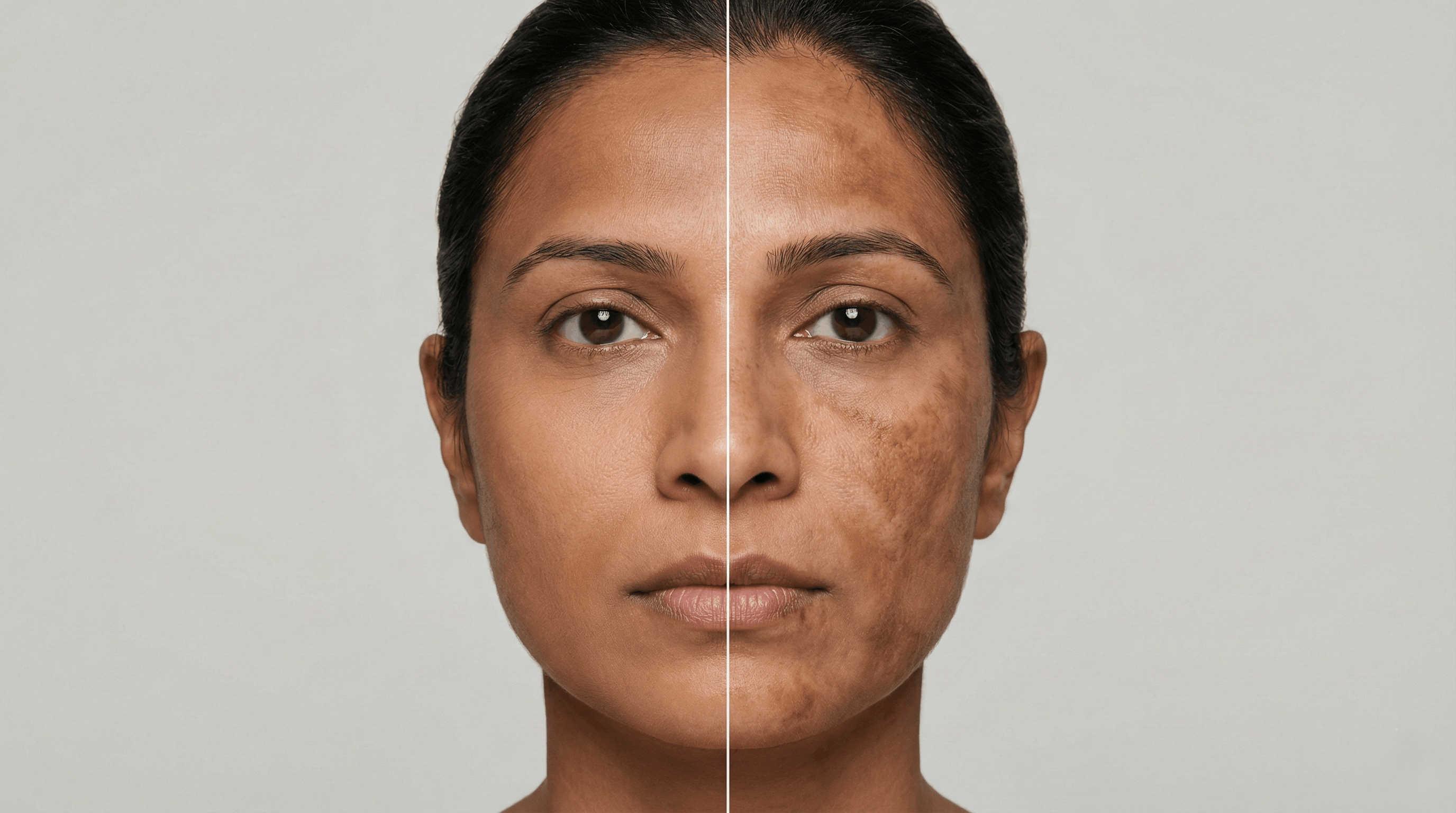
"I just need to scrub this tan off." This single sentence is responsible for more damaged skin barriers in India than almost any other skincare myth. We use the words "Tan" and "Pigmentation" interchangeably, assuming they are the same thing: simply dark skin that needs to be brightened.
But biologically, they are as different as a bruise and a burn. One is a surface-level oxidation process; the other is a deep-seated inflammatory injury. Treating one like the other is not just ineffective—it is dangerous.
If you have been scrubbing your face with harsh soaps, using lemon juice, or exfoliating daily hoping to "remove" a dark patch, and it is only getting darker, this guide is for you. We are going to clarify the difference once and for all.
The Core Difference: Oxidation vs. Inflammation
To treat your skin correctly, you must stop looking at the color and start looking at the cause.
1. What is Tanning? (The Shield)
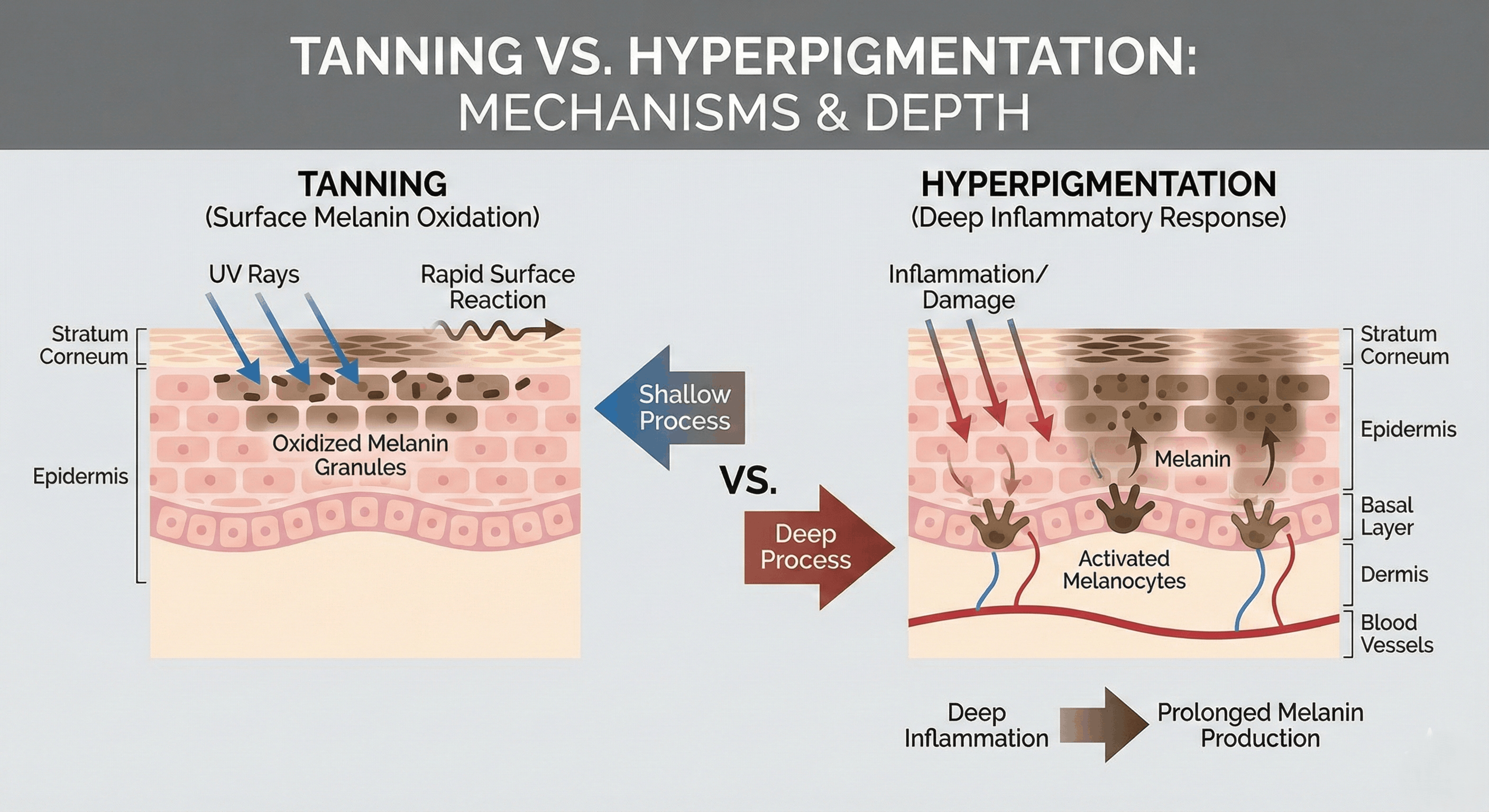
Tanning is your skin's immediate defense mechanism. When UV rays hit your skin, the melanin that is already present in your cells undergoes a chemical reaction called Immediate Pigment Darkening (IPD). It oxidizes, turning darker, much like a sliced apple turns brown when left out.
This happens in the Epidermis (the top layer). It is your skin trying to act as an umbrella to shield your DNA from radiation. It is healthy. It is temporary. It is uniform.
2. What is Hyperpigmentation? (The Wound)
Hyperpigmentation—whether it is Melasma, Post-Inflammatory Hyperpigmentation (PIH), or Solar Lentigines—is a response to Injury or Chronic Stress.
It involves the Dermal-Epidermal Junction (deeper layer). It happens when melanocytes are damaged or over-stimulated by hormones, heat, or trauma (like popping a pimple). They dump excess pigment into the lower layers of the skin, like ink leaking into a fabric.
Key Takeaway
You can scrub off a tan because it is on the surface. You cannot scrub off pigmentation because it is deep inside the skin. Scrubbing pigmentation only irritates the wound, causing more pigment to leak.
The Self-Diagnosis Test: Which One Do You Have?
Before you buy another serum, stand in front of a mirror with good natural light and take this 3-step test.
| Feature | Tanning | Hyperpigmentation |
|---|---|---|
| The Border | Blurred, diffuse, gradual fade. | Sharp, defined edges or distinct patches. |
| The Trigger | Appears after a beach trip or long drive. | Appears after acne, a rash, or hormonal change. |
| The Color | Golden, bronze, or general darkening. | Dark brown, slate gray, or purple-ish. |
Protocol A: Treating the Tan
If you diagnosed yourself with a Tan, your goal is Exfoliation + Hydration.
- Exfoliate: Use mild AHAs (Lactic Acid) or enzymatic powders 2x a week to lift the dead, darkened cells.
- Hydrate: New skin cells need moisture to look bright. Use Hyaluronic Acid.
- Protect: High SPF to prevent re-oxidation. Check our Natural Glow Guide for maintenance.
Protocol B: Treating Hyperpigmentation
If you diagnosed Hyperpigmentation, your goal is Inhibition + Barrier Repair.
- Stop Scrubbing: Throw away physical scrubs. Do not use loofahs on the face.
- Inhibit: Use ingredients that tell melanocytes to sleep: Alpha Arbutin, Licorice Root, Azelaic Acid.
- Calm: Use Centella Asiatica or Panthenol to reduce the inflammation signal.
- Patience: This takes 3-6 months. Do not rush.
The Universal Bridge: How to treat both safely
Is there a way to treat dullness (tan) without aggravating spots (pigmentation)? Yes. You need a Non-Invasive Detox.
Product Recommendation: The Raw Multani Mitti
This is the safest middle ground. The Raw Multani Mitti provides the exfoliation needed to lift a tan, but because it is mineral-rich and cooling, it soothes the inflammation associated with pigmentation.
Pro Tip: Mix with Rose Water. Rose water is anti-inflammatory (good for pigmentation) while the clay lifts surface dullness (good for tan).
Shop The Raw Multani MittiWritten by Syed Muzamil — Skincare Researcher & Founder at Ethereal Glow.

Try These Clean, Natural Essentials
Gentle, ayurvedic-inspired skincare to support the routine in this article.
Vitamin Orange
A refreshing blend of Multani Mitti and orange peel powder for brighter-looking skin.
The Raw
Pure, unblended Multani Mitti clay for deep cleansing, oil control, and clear-looking skin.", description: "The Raw is Ethereal Glow’s purest form of Multani Mitti — finely milled, unblended, and free from additives. Designed for oily and acne-prone skin, it helps absorb excess oil, cleanse pores, and refresh tired skin naturally.
Complete Your Ritual
Finish reading? Take the next step with products that match this routine.
Vitamin Orange
A refreshing blend of Multani Mitti and orange peel powder for brighter-looking skin.
The Raw
Pure, unblended Multani Mitti clay for deep cleansing, oil control, and clear-looking skin.", description: "The Raw is Ethereal Glow’s purest form of Multani Mitti — finely milled, unblended, and free from additives. Designed for oily and acne-prone skin, it helps absorb excess oil, cleanse pores, and refresh tired skin naturally.
Related Articles
The Paradox of Clean Skin: Why Over-Cleansing Weakens Barriers
Think 'squeaky clean' means healthy? Think again. Discover why over-cleansing is the root cause of oily skin, acne, and barrier damage.
Is Your Moisture Barrier Damaged? A Dermatologist Checklist
Tightness, stinging, or sudden acne? These aren't just 'bad skin days'. Use this diagnostic checklist to identify barrier damage and fix it safely.
Why Pigmentation Returns Every Summer: The Barrier-Melanin Link
Does your pigmentation fade in winter only to return in summer? It's not just the sun. Discover how thermal stress and barrier damage trigger 'melanin memory'.
Common Questions
Tags
Turn today's skincare lesson into a real glow.
Explore our Multani Mitti and ubtan blends crafted for Indian skin.