Ayurveda vs Actives: Treating Dark Spots Without Triggering PIH
Aggressive chemicals can backfire on Indian skin. We compare modern Actives vs Ayurveda to find the safest path for dark spots.
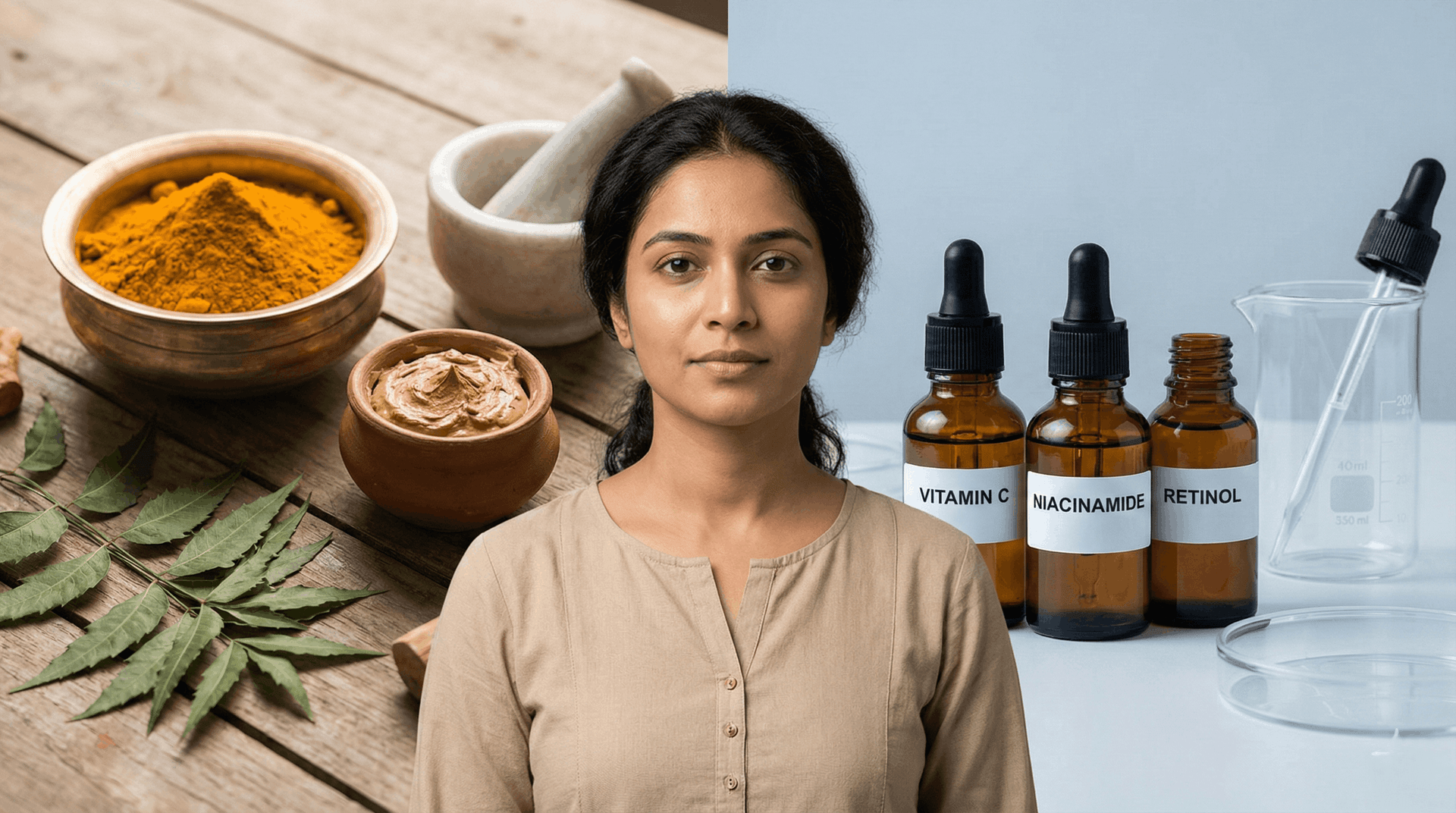
Ayurveda vs Actives: Treating Dark Spots Without Triggering PIH
There is a silent epidemic in the Indian skincare community: Chemical Burns. Influenced by western skincare trends, thousands of teenagers and young adults are buying high-percentage Glycolic Acid toners, 2% Salicylic Acid serums, and Retinols, hoping to erase their dark spots.
The result? For many, the spots don't disappear. They get red, then itchy, and finally, they turn a dark, stubborn slate-gray. This is called PIH (Post-Inflammatory Hyperpigmentation), and it is the skin's way of saying, "You went too far."
In this in-depth analysis, we are going to compare two opposing philosophies: The modern "Active" approach vs. the traditional "Ayurvedic" approach. We will see why "Faster" isn't always "Better," especially for melanin-rich skin.
The Active Paradox: Why Stronger Can Be Worse

Modern Actives (AHAs, BHAs, Retinoids) operate on the principle of Cellular Acceleration. They force the skin to shed cells faster than it naturally wants to.
For Caucasian skin (Fitzpatrick I-III), this is often fine. But Indian skin (Fitzpatrick IV-VI) has a different temperament. Our melanocytes are extremely sensitive to inflammation. When you use a strong acid, you might strip the dark spot, but you also irritate the skin cells around it.
The Rebound Effect
The irritation triggers the release of inflammatory mediators (prostaglandins). These mediators bind to melanocytes and stimulate more pigment production. So, while you exfoliated the old spot, you triggered the creation of a new, deeper one.
The Ayurvedic Philosophy: Calm Before Correction
Ayurveda takes the opposite approach. It views pigmentation not as a "stain" to be scrubbed, but as a symptom of "Pitta" (Heat/Fire) imbalance in the blood (Rakta Dhatu).
Therefore, the goal of Ayurveda is not to strip the skin, but to cool the blood and pacify the inflammation.
- Manjistha (Rubia Cordifolia): Known as a blood purifier. It works on the vascular level to reduce the redness that eventually turns brown.
- Liquorice (Mulethi): The original Tyrosinase Inhibitor. It stops the enzyme that makes melanin without irritating the skin.
- Sandalwood (Chandan): The ultimate coolant. It physically lowers skin temperature, preventing thermal-induced pigmentation.
Head-to-Head Comparison: Actives vs. Ayurveda
| Criteria | Modern Actives (e.g., Glycolic Acid) | Ayurvedic Herbs (e.g., Manjistha) |
|---|---|---|
| Speed of Results | Rapid (2-4 weeks). | Slow (8-12 weeks). |
| Risk of PIH | High (if overused/no SPF). | Near Zero. |
| Barrier Impact | Thinning/Stripping. | Strengthening/Nourishing. |
| Best For | Thick, oily, non-sensitive skin. | Sensitive, acne-prone, heat-sensitive skin. |
The Hybrid Protocol: The Best of Both Worlds
We are not saying you must throw away your serums. Science is beautiful. But you must use science with the wisdom of Ayurveda. We call this the Hybrid Sandwich Method.
Phase 1: Barrier Repair (Weeks 1-2)
Do not use any acids. Focus on Ceramides, Centella, and Ayurvedic oils. Get your skin to a point where it doesn't sting.
Phase 2: Introduction (Weeks 3-6)
- Morning: Ayurvedic Protection. Use a simple cleanser and heavy sun protection.
- Evening: Gentle Active. Use a low % Niacinamide (5%) or Azelaic Acid. These are anti-inflammatory actives. Avoid high % AHA.
Phase 3: The Maintenance Ritual (Weekly)
This is where you bridge the gap. You need an exfoliant that acts like an herb.
The Safe Exfoliant: Multani Mitti
The Raw Multani Mitti is chemically composed of minerals that absorb oil (like Salicylic Acid) but is physically cooling (like Sandalwood).
Using this once a week ensures you are turning over dead skin cells without shocking the melanocytes with heat or chemical burns.
Shop The Raw Multani MittiFinal Verdict
If you have Indian skin, speed is your enemy. The faster you try to force a spot to leave, the longer it will stay. Embrace the Ayurvedic principle of cooling and calming. Support your barrier first, and the pigmentation will fade as a side effect of healthy skin.
Written by Syed Muzamil — Skincare Researcher & Founder at Ethereal Glow.

Est. Glow Editorial Team
Complete Your Ritual
Finish reading? Take the next step with products that match this routine.
Related Articles
Can You Use Multani Mitti Every Day? Science-Based Clay Guide
No — daily use damages your barrier. Get the dermatologist-aligned frequency by skin type, the 10-minute rule, and the clinical evidence on clay masks.
The Paradox of Clean Skin: Why Over-Cleansing Weakens Barriers
Think 'squeaky clean' means healthy? Think again. Discover why over-cleansing is the root cause of oily skin, acne, and barrier damage.
Is Your Moisture Barrier Damaged? A Dermatologist Checklist
Tightness, stinging, or sudden acne? These aren't just 'bad skin days'. Use this diagnostic checklist to identify barrier damage and fix it safely.
Common Questions
Tags
Turn today's skincare lesson into a real glow.
Explore our Multani Mitti and ubtan blends crafted for Indian skin.