Can You Use Multani Mitti Every Day? Science-Based Clay Guide
No — daily use damages your barrier. Get the dermatologist-aligned frequency by skin type, the 10-minute rule, and the clinical evidence on clay masks.
Last updated: August 2026 | Medically reviewed against peer-reviewed sources
Multani mitti is not safe for daily use on your face. The clinically supported frequency is once or twice per week for oily and combination skin, once a week for normal skin, and once every one to two weeks for dry or sensitive skin — always washing the mask off after 10 to 15 minutes, while it is still slightly tacky.
Bentonite clay is a highly porous, naturally occurring smectite mineral composed primarily of montmorillonite that uses a high cation-exchange capacity to physically adsorb surface lipids, impurities, and bacteria from the stratum corneum. That mechanism is exactly why it works — and exactly why overusing it backfires.
What is the scientific mechanism behind clay masks?
Clay masks work through a physical process called cation exchange capacity (CEC). When you mix fuller's earth with water, the smectite particles swell into a porous, negatively charged matrix. As the mask dries, this matrix adsorbs positively charged particles — excess sebum, debris, and certain bacteria — from the uppermost layer of skin (the stratum corneum), without harsh surfactants. Think of it as a molecular sponge rather than a chemical cleanser.
This is also why clay feels tightening as it dries: water is evaporating out of the porous matrix, and the same porosity that draws oil out will start drawing moisture from your skin if you leave it on too long.
How often should you use Multani mitti? (Can you use it daily?)
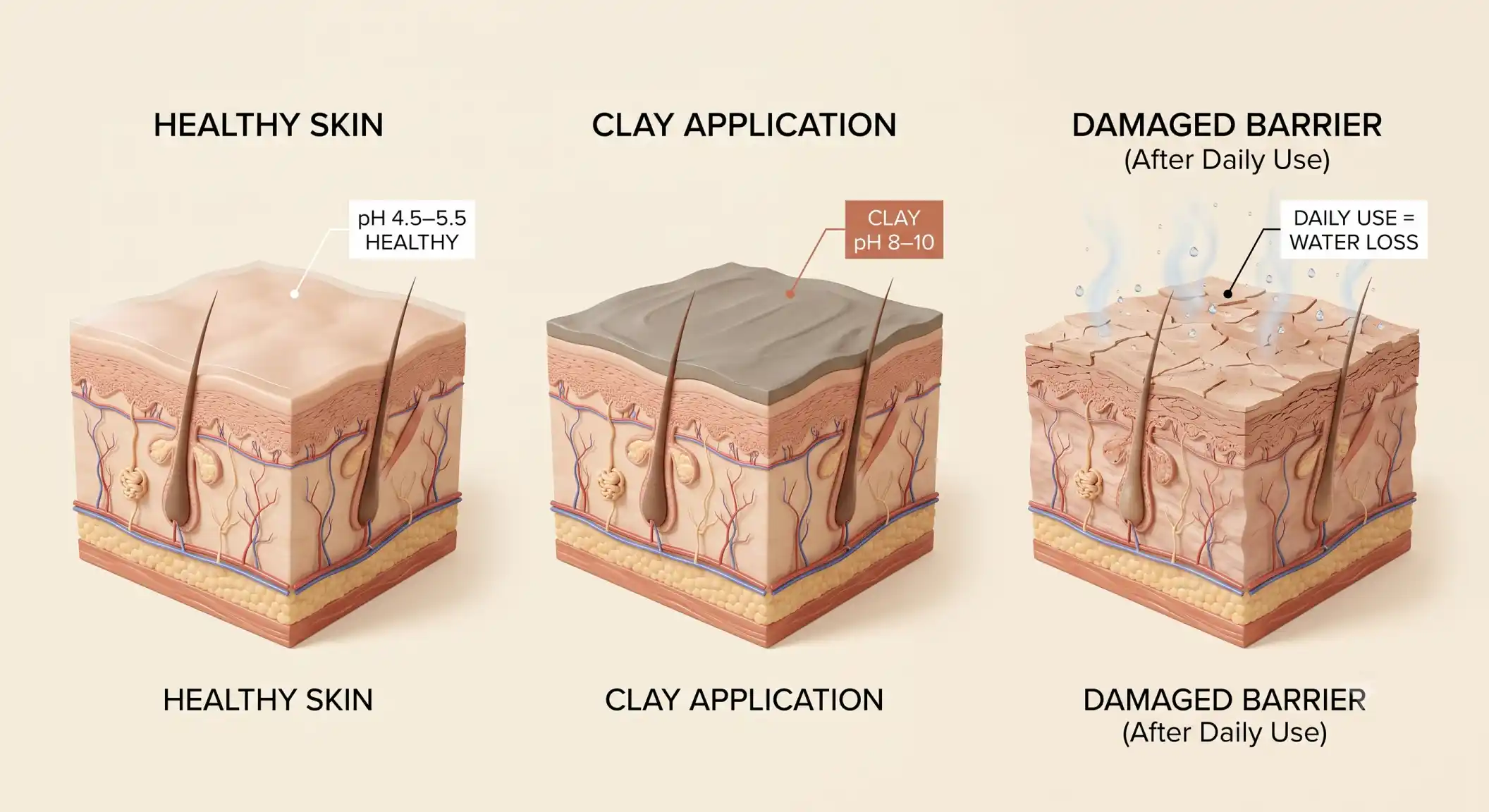
Dermatologists advise against daily use. Raw clays are naturally alkaline (typically pH 8–10), while healthy facial skin maintains an acidic mantle of roughly pH 4.5–5.5. Daily application repeatedly disrupts that acid mantle, increases transepidermal water loss (TEWL), and can strip ceramides from the stratum corneum — which is why some people who use multani mitti every single day end up with paradoxically oilier skin and more breakouts, a rebound effect sometimes called compensatory seborrhea.
The safe rhythm is simple: treat clay as a weekly deep-cleanse, not a daily cleanser.
- Oily skin: 2 times per week maximum
- Combination skin: 1–2 times per week (T-zone only on the second day)
- Normal skin: 1 time per week
- Dry skin: once every 1–2 weeks, with hydrating mixers only — see our Multani mitti for dry skin guide
- Sensitive or compromised skin: patch test first; once every 2 weeks at most, and skip entirely during flare-ups
Frequency guide by skin type (quick reference)
| Skin type | Max frequency | Contact time | Best mixer |
|---|---|---|---|
| Oily / acne-prone | 2x per week | 10–15 min | Rose water or plain water |
| Combination | 1–2x per week | 10 min | Water; yogurt for cheeks |
| Normal | 1x per week | 10 min | Milk or rose water |
| Dry | Every 1–2 weeks | 8–10 min | Milk, honey, curd |
| Sensitive | Every 2 weeks + patch test | 8 min | Curd or aloe |
The "tacky phase" rule: when exactly to wash it off
A drying clay mask moves through three phases, and the phase you stop at decides whether the ritual helps or harms:
- Wet phase (minutes 0–5): active adsorption; the clay draws in lipids and water alike.
- Tacky phase (roughly minutes 5–15): the surface is set but still slightly sticky. This is the sweet spot — pores clarified without draining your skin. Wash off here.
For glow-specific mixers and ratios, our natural glow skin guide pairs each additive with the skin type it suits best. If your mask has ever made your face feel like parchment, you wore it into the cracked phase. Rinse while tacky, moisturize immediately. If tightness persists, check whether it's normal dehydration or actual barrier damage with this dermatologist checklist.
Bentonite vs Multani Mitti: what's the difference?
The primary difference between multani mitti and bentonite clay is origin and draw strength:
| Clay type | Mineral origin | Cation exchange capacity | Best suited for |
|---|---|---|---|
| Multani mitti (fuller's earth) | Sedimentary deposits, Indian subcontinent | Moderate | Oily/combination skin, uneven tone, weekly clarification |
| Calcium bentonite | Aged volcanic ash | Very high | Very oily, congested, acne-prone skin |
| Kaolin | Kaolinite mineral | Low | Dry, sensitive skin; gentle clarification |
In practice: moderately oily skin wanting a sustainable ritual should choose multani mitti; heavy congestion responds to cosmetic-grade calcium bentonite — used less frequently, not more.
Comparing across the other common kitchen-and-counter options? We have dedicated breakdowns for multani mitti vs besan by skin type and Ethiglo soap vs multani mitti.
What does clinical research actually show?
Acne outcomes. In an add-on randomized controlled trial published in the Journal of Cosmetic Dermatology (Salimi et al., 2025), 60 patients with moderate acne used a bentonite-based mask alongside standard therapy. Over eight weeks, total lesion count fell by a mean of 55.45% versus 21.74% for placebo, and the Acne Severity Index dropped 66.33%. Patient satisfaction: 43.3% of the clay group reported being very satisfied versus 3.3% of placebo. Honest caveats: it was an add-on trial (combined with oral medication) and the formulation included a soothing botanical extract — raw clay alone is not automatically equivalent.
Oily skin. A 2023 assessment in Skin Research and Technology evaluated clay masks in oily and acne-prone skin and found meaningful reductions in surface oil and comedones, with dryness and irritation as main adverse effects — reinforcing the contact-time rules above.
Broader dermatology. A 2024 review in Archives of Dermatological Research compiled evidence on anti-inflammatory, oil-absorbing, wound-healing, and UV-scattering properties of bentonites and montmorillonites, while calling for larger randomized trials before strong medical claims. Published research has also explored clays for contact irritation and infant skin recovery — properly used clay is generally well tolerated.
Honest bottom line: clay manages shine and supports acne-prone skin; it doesn't rewire sebaceous glands, and surface-oil reduction after a rinse-off mask is temporary. For severe acne, dermatologist-prescribed treatment comes first.
5 mistakes that make clay masks damage your skin
- Daily use. Repeated alkaline exposure degrades the acid mantle — see the frequency table.
- Sleeping in it. Hours of contact causes severe dehydration and redness. Never.
- Applying to bone-dry skin. Dampen first so clay targets oil, not your moisture reserves.
- Stacking with harsh actives same-session. Don't combine clay nights with salicylic acid or retinoids — see Ayurveda vs actives for scheduling.
- Skipping aftercare. Rinse, pat, moisturize within three minutes.
The scientific ritual protocol
- Damp skin, once or twice weekly per your type.
- Mix cosmetic-grade powder with rose water or water into a smooth paste (glass/wood bowl).
- Apply evenly, avoiding eyes and lips.
- Set a 10–15 minute timer; rinse at the tacky phase.
- Moisturize immediately.
Cosmetic grade matters: gritty impurities like quartz cause micro-abrasion. Our premium multani mitti powder (The Raw) is triple-sifted and sun-dried — fine texture, nothing added.
Where clay fits in a full routine
Clay night should stand alone — not stacked with exfoliating acids. For complete frameworks see the best Indian skincare routine and the summer routine for oily skin in India, and tune frequency across weather using our seasonal skincare tips. If tan rather than oil is your concern, start with tan vs hyperpigmentation.
FAQs
Can I use multani mitti on my face everyday?
No. Daily application strips the acid mantle and accelerates water loss from the stratum corneum. Limit use to 1–2 times per week depending on skin type.
What happens if we apply multani mitti daily?
Tightness, flaking, increased sensitivity, and often rebound oiliness — the stripped barrier compensates by producing more sebum.
How long should I leave multani mitti on my face?
Wash off after 10 to 15 minutes, while still slightly tacky. A fully dried, cracking mask actively dehydrates skin.
Does multani mitti remove dark spots?
Indirectly: by exfoliating pigmented cells and supporting cellular turnover it promotes brighter, even tone over weeks. It is not a targeted pigment treatment.
Is bentonite clay the same as multani mitti?
No. Bentonite forms from aged volcanic ash with higher cation exchange capacity; multani mitti is sedimentary fuller's earth with moderate draw.
Can I sleep with multani mitti on my face?
No. Overnight contact causes significant dehydration, redness, and rebound oil production. Ten to fifteen minutes is the ceiling.
Start with the Purest Base
You likely have clay in your kitchen, but is it pure? Store-bought clays often contain sand and grit. Our The Raw Multani Mitti is triple-sifted and sun-dried for a silk-like texture.
Shop The Raw Multani Mitti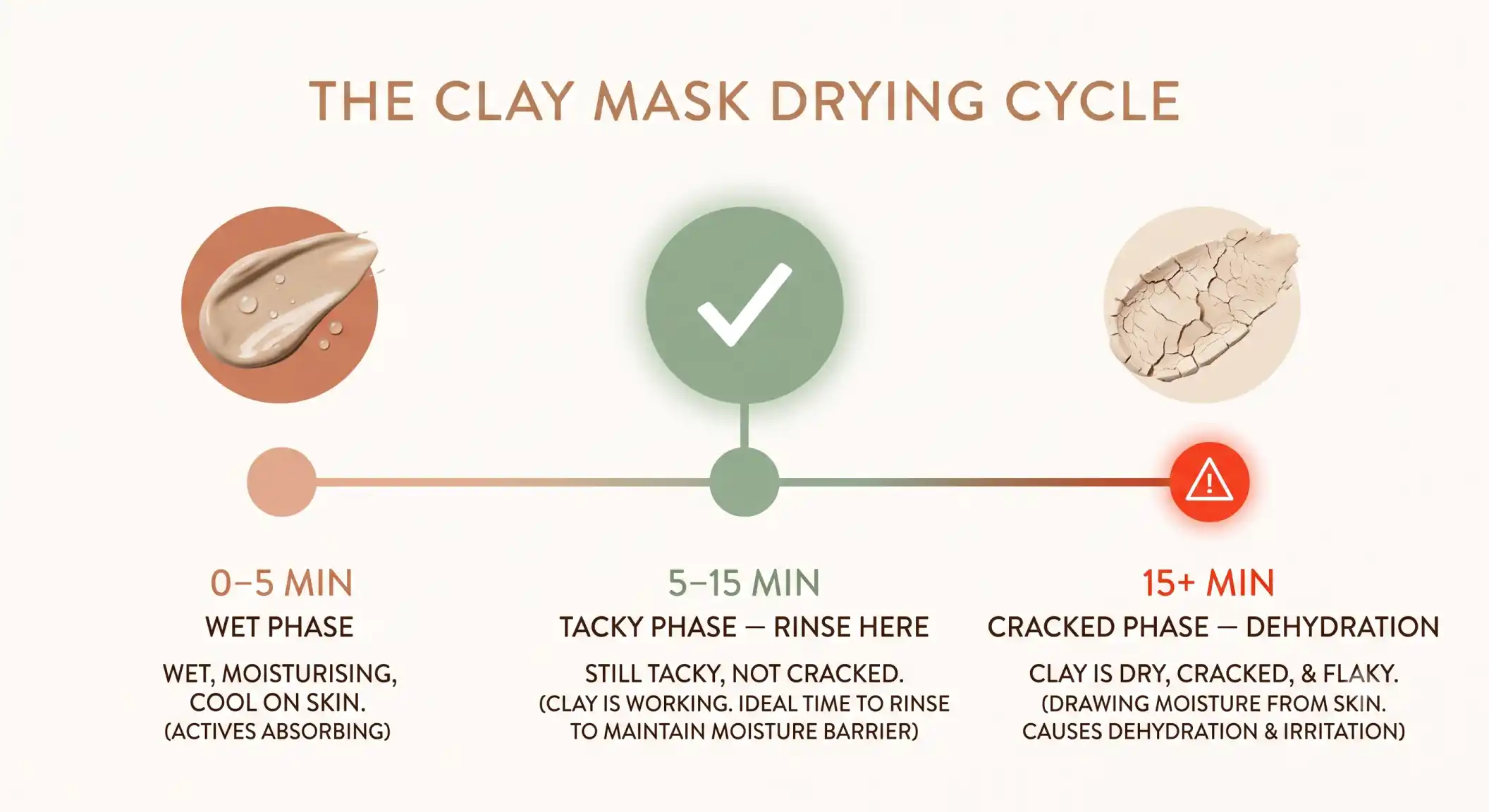

Est. Glow Editorial Team
Complete Your Ritual
Finish reading? Take the next step with products that match this routine.
Related Articles
The Paradox of Clean Skin: Why Over-Cleansing Weakens Barriers
Think 'squeaky clean' means healthy? Think again. Discover why over-cleansing is the root cause of oily skin, acne, and barrier damage.
Multani Mitti vs. Besan: The Definitive Guide for Your Skin Type
Confused between Multani Mitti and Besan? We break down the science, benefits, and which one wins for oily, dry, and acne-prone skin. Plus, expert DIY recipes.
How to Layer Actives With Multani Mitti Safely (Niacinamide, BHA)
Clay + actives wreck barriers when stacked wrong. Exact wait times, night scheduling, and skin-type rules for niacinamide, salicylic acid and multani mitti.
Common Questions
Tags
Turn today's skincare lesson into a real glow.
Explore our Multani Mitti and ubtan blends crafted for Indian skin.